

Before you buy your next Ikkat Kurta Sets for Women, it is worth knowing what you are actually looking at. The ikat pattern on your kurta did not come from a screen printing machine or a digital press. It was woven by hand in a process that begins with individual threads, days of patient work, and a level of mathematical precision that has fascinated textile historians for centuries.
This is a cluster guide. For the full product overview and buying guide, read our pillar article: The Ultimate Guide to Ikkat Kurta Sets for Women.
|
What is Pochampally ikat and why is it special? Pochampally ikat is a handwoven resist dyed textile made in Pochampally village in Telangana, India. It holds a Geographical Indication (GI) tag, which means only fabric made in Pochampally can legally carry this name. It is especially known for its double ikat technique, where both the warp and weft threads are resist dyed before weaving, creating complex geometric patterns with natural blurred edges. India, Indonesia, and Japan are the only three countries in the world where double ikat is still produced commercially. |
Where Does Pochampally Ikat Come From?
Pochampally is a village about 50 kilometres from Hyderabad in Telangana, India. It has been a weaving centre for centuries and today thousands of weaving families in and around Pochampally still produce ikat fabric on traditional pit looms. The village is often called the ikat capital of India and was recognised in 2009 by the United Nations World Tourism Organization as one of the ten best textile and craft villages in the world.
Pochampally ikat received a Geographical Indication (GI) tag from the Indian government, legally protecting the name and ensuring that only genuinely Pochampally made fabric can be called Pochampally ikat. When you buy Ikkat Kurta Sets for Women from Indian Summer, we source directly from weaving clusters and every piece we stock is a verified handloom creation.
How Pochampally Ikat is Made: The Complete Process
|
How is Pochampally ikat fabric made? Pochampally ikat is made in five main stages. First the weaver designs the pattern on graph paper. Then the threads are stretched on a frame and sections that should resist the dye are tightly bound with rubber or thread. The bound threads are dipped in dye. The bound sections stay undyed while the rest takes color. Multiple rounds of binding and dyeing create multiple colors. Finally the dyed threads are carefully arranged on a pit loom and woven. The weaver must align the pattern precisely as they weave, row by row. Any misalignment distorts the final design. |
Stage 1: Designing on Graph Paper
The weaver begins by plotting the design on graph paper. Each color, each thread position, and each pattern segment must be calculated before a single thread is touched. In complex double ikat designs, this planning stage alone can take several days.
Stage 2: Binding the Threads
The warp or weft threads (or both, in double ikat) are stretched on a frame. The sections that should resist the dye are tightly bound with rubber bands, wax thread, or rubber tubes. The precision of the binding determines the precision of the final pattern.
Stage 3: Resist Dyeing
The bound threads are dipped in dye baths. The bound sections resist the dye and remain in their original color. To create a multicolor pattern, this process is repeated: the threads are untied, re-bound in new sections, and dipped in a different color. This can happen three to seven times for a complex multicolor ikat.
Stage 4: Weaving on the Pit Loom
The dyed threads are carefully wound onto the loom in the exact sequence required by the design. The weaver then weaves the weft threads through the warp, row by row, constantly checking that the pattern is aligning correctly. This stage requires the greatest precision and is where the weaver's skill is most clearly demonstrated.
Stage 5: The Finished Fabric
The completed fabric has the natural, slightly blurred edges that are the signature of genuine ikat. This blurring happens because threads shift very slightly during the weaving process and cannot be prevented. It is what distinguishes genuine Ikkat Kurta Sets for Women from machine printed ikat alternatives.
Single Ikat vs Double Ikat: What Is the Difference?
|
What is the difference between single ikat and double ikat? In single ikat, only one set of threads (either the warp or the weft) is resist dyed before weaving. In double ikat, both the warp and weft threads are resist dyed. Double ikat is significantly more complex because the weaver must align two independently dyed sets of threads so that their patterns match perfectly in the final fabric. India, Indonesia, and Japan are the only countries where double ikat is still produced. Double ikat takes much longer to make and is therefore more expensive and more premium. |
A Living Example of Double Ikat: The Panna Kurta Set
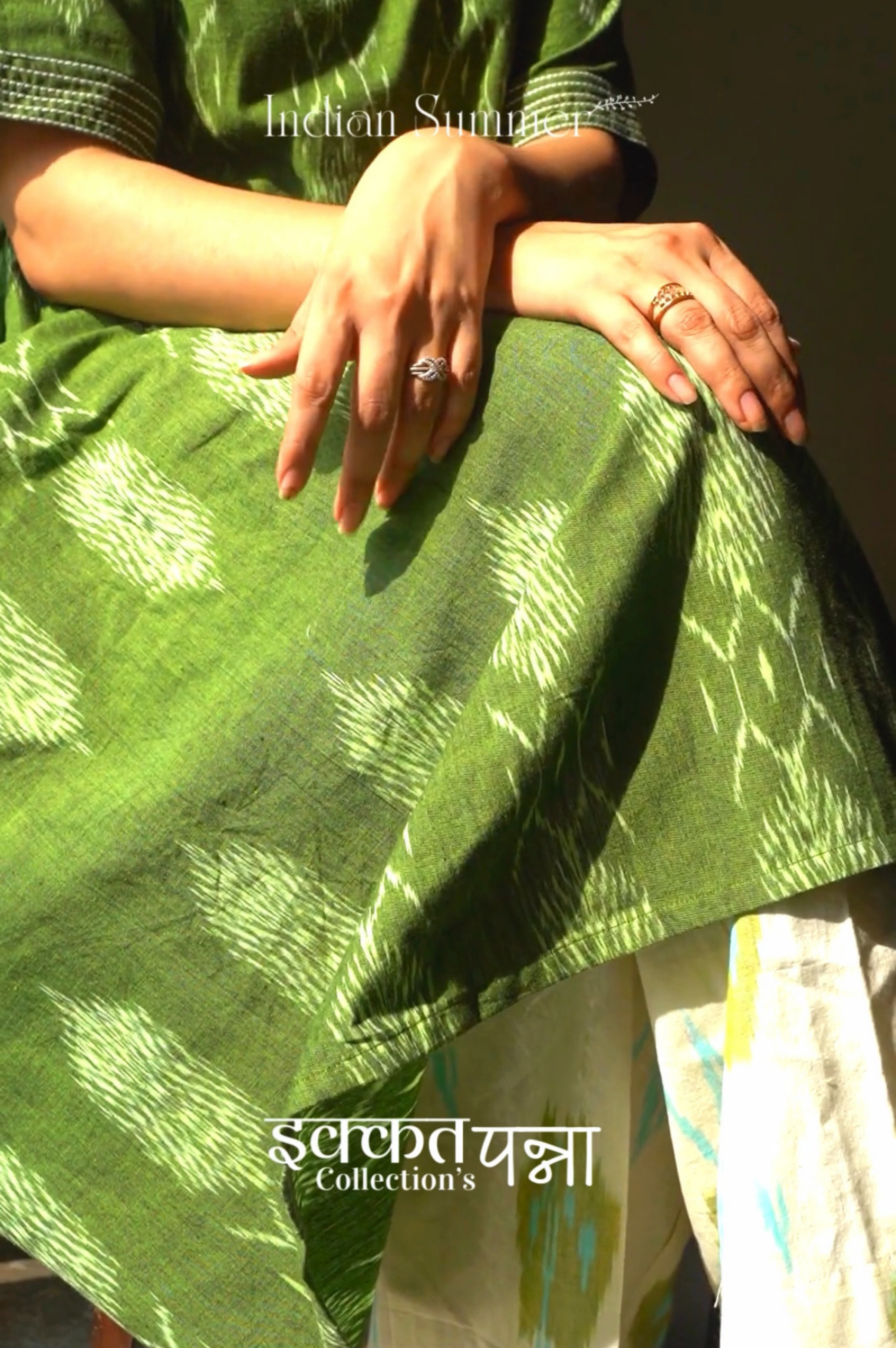
The Panna Double Ikkat Kurta Set in our collection is a genuine double ikat cotton piece. Both the kurta fabric and the contrasting off-white pants are crafted in double ikat cotton. The V-anchor threadwork neckline and the flattering A line silhouette with gathers under the bust make this a beautifully designed garment, not just a fabric showcase. At Rs. 7,300 it represents the craft value of genuine double ikat at a price that makes it accessible. It is one of the finest examples of authentic Ikkat Kurta Sets for Women craftsmanship available online.
|
Shop This: Panna Double Ikkat Kurta Set for Women | Rs. 7,300 Genuine double ikat cotton A-line kurta with V-anchor threadwork neckline and off-white ikat pants. The finest handloom piece in our ikkat collection. |
How to Identify Genuine Handloom Pochampally Ikat
|
How do I identify authentic Pochampally ikat vs machine printed ikat? Authentic Pochampally ikat has three identifiers. First, the pattern edges are slightly blurred or feathered, not perfectly sharp. Second, the fabric has a slightly uneven texture on both sides because the pattern is woven through the cloth. Third, no two pieces are exactly identical because of natural variations in the hand dyeing and weaving process. Machine printed ikat has perfectly sharp edges, identical patterns on every piece, and the design only appears on one side of the fabric. |
Why Buying Handloom Ikat Supports Indian Artisans
The Ikkat Kurta Sets for Women you buy at Indian Summer is not produced in a factory. It is woven by hand by artisan families in weaving communities in Telangana. Each piece represents anywhere from one to several days of skilled labor. When you buy authentic handloom ikat, you are paying for that skill and time directly, and you are contributing to the continuation of a craft tradition that is on the UNESCO intangible cultural heritage consideration list.
-
One metre of quality Pochampally double ikat takes one to several days to produce
-
The GI tag legally protects the name and origin of Pochampally ikat
-
Thousands of weaving families in Telangana depend on ikat for their livelihood
-
Choosing handloom over printed ikat is a direct investment in Indian craft heritage
Frequently Asked Questions
Is all ikat the same as Pochampally ikat?
No. Ikat is a technique practiced in many regions of India and around the world. Pochampally ikat specifically refers to ikat woven in and around Pochampally village in Telangana and is protected by a GI tag. Other significant Indian ikat traditions include Sambalpuri ikat from Odisha and Patola from Gujarat. Each has its own distinct pattern vocabulary and weaving style.
How long does it take to make one Pochampally ikat kurta set?
A basic single ikat Ikkat Kurta Sets for Women takes about two to three days to produce from binding to weaving. A complex double ikat piece like the Panna Double Ikkat Kurta Set can take significantly longer because both warp and weft threads must be individually resist dyed and then aligned perfectly during weaving.
Does Pochampally ikat have a GI tag?
Yes. Pochampally ikat received a Geographical Indication tag from the Indian government. This legally protects the name Pochampally ikat and ensures that only fabric genuinely made in the Pochampally weaving cluster can carry this designation.
Where can I buy authentic Pochampally ikat kurta sets online?
You can buy genuine handloom Ikkat Kurta Sets for Women including double ikat pieces like the Panna Double Ikkat Kurta Set at Indian Summer. We source directly from weaving clusters and all our ikat pieces are verified handloom creations.
Shop Now: Ikkat Kurta Sets for Women
Back to Pillar Guide: The Ultimate Guide to Ikkat Kurta Sets for Women